Manila to Mindanao
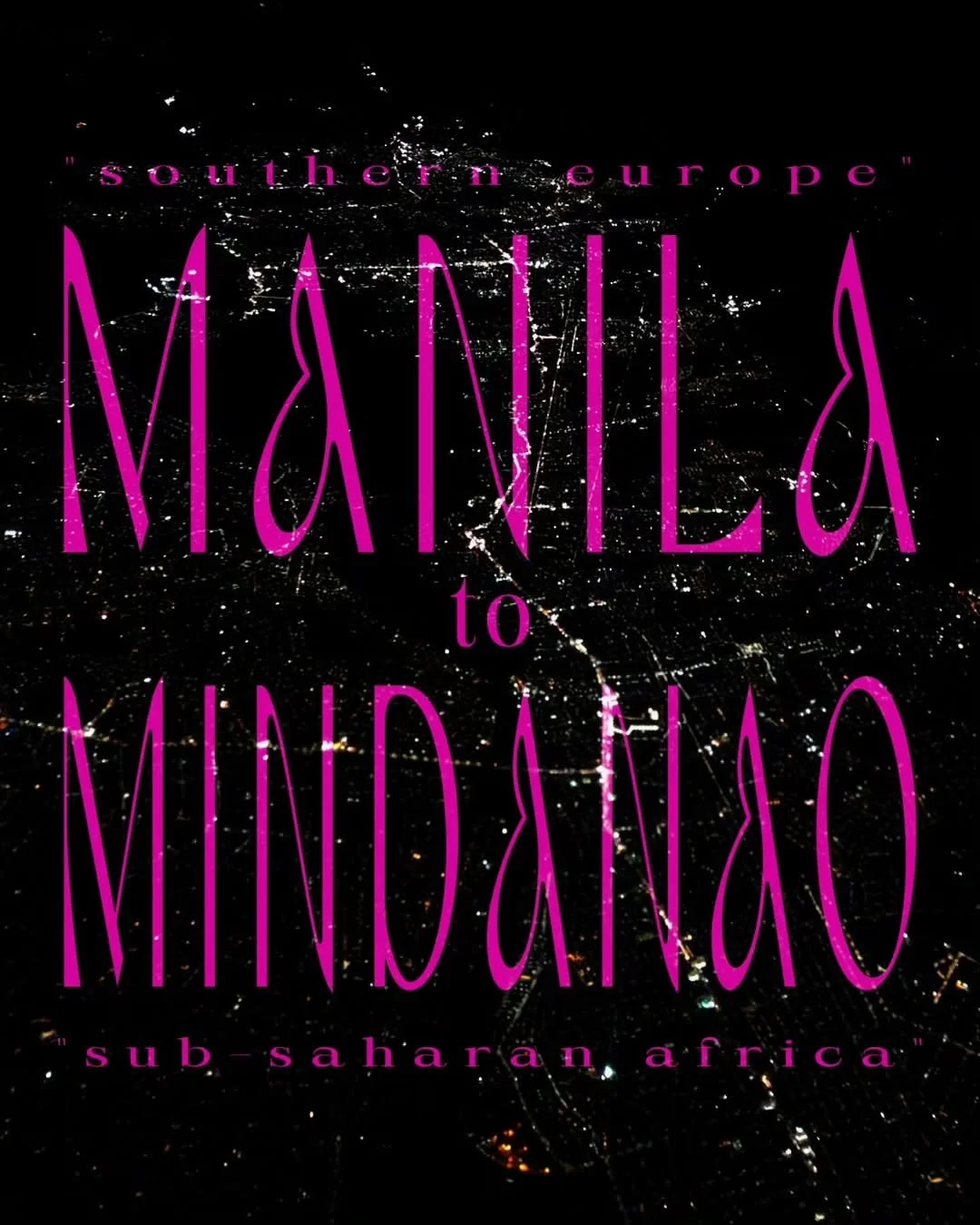
We just posted an excerpt of Carl’s article for Kapanahonan Vol. 1 on Instagram, and it felt fitting to share this post I made last year when the Richard Heydarian issue came up. The subtitles are a reference to his statement about Manila’s Human Development Index being “Southern Europe” (in all my years of living there and actually visiting Southern Europe, in no way, shape, or form will NCR ever resemble that, no matter what data says) while Mindanao was “Sub-Saharan Africa”.
RM also discusses this in his article for Vol. 1, where he states:
Some argued that the backlash from Mindanaons was rooted in a refusal to be compared to Africans — a shallow interpretation that overlooks the deeper issue: Heydarian’s statement glorified the north while diminishing Mindanao, failing to consider the complex historical and cultural contexts that shape these identities. This framing not only reveals a bias but also reinforces the North’s long-standing prejudice against Mindanao, which often oscillates between perceptions of terrorism, war, savagery, exoticism, and poverty.
If you watch the clip, one could catch the condescension in Heydarian’s tone. I also am a firm believer that data will never exemplify lived experience. Using averaging and mathematics to communicate exponentially multi-factored daily life renders it to gross oversimplification. Outliers pull averages up, which would make it one or a few against the experience of millions.
Some Mindanaons found comedy in the issue and composed a song:
Returning to my post, the caption I wrote follows:
People who knew me in high school know that I pursued the question "what does it mean to be a Filipino today?" My final research paper in senior year spoke of how the beauty of the Philippines is severely underestimated by our own people, shaped by the lens of our colonizers. The very same lens that Richard Heydarian took in his recent CNN interview.
Being exposed to non-Filipinos since childhood taught me that many people see the Philippines as inefficient, gritty, and ugly. Foreigners from “first-world” nations and those in the upper class who identified with them looked through their noses upon us as from a “lesser civilization” (if they would even use the word civilization for us).
I was once told by a foreigner who worked in my family business for more than 10 years that their nation had “2000 years of history, but the Philippines has none.” To say I was shocked and offended is an understatement. Even when we come from the capital, we are seen as backwards and undeveloped, and that sadly continues with people I encounter.
My journey as a professional creative in the development sector helped me explore many sides to our nation. Eventually, I was called to the South, specifically Mindanao. All that I heard about suddenly came to life, and I was enthralled. I became a more conscious culturalist, and I was lucky to meet all these amazing people that disproved all the prejudice circulating my region.
Hearing news never fazed me, so it shocked people to think I would move here. Some would call it courage, others would call it foolishness. They say I would “learn my lesson” and truly I did: that the world is a wide place, and those who dismiss it are terrified of acknowledging their nanoscopic place in it.
Did I manage to answer the question I asked all those years ago? Luckily, yes. It is dynamic and transforming, as anything with breath is. I continue to learn about the infinite colors that this archipelago sparkles with.
So what does that mean for a Manila-to-Mindanao girl like me? You’ll see soon enough when the balay is built 💎
This is the song that accompanies my post:
The deepest irony of Philippine tourism is that the institution props up the aesthetics of the various ethnolinguistic groups across the major island-regions, yet do not make concerted efforts in educating people beyond it’s patterns and colors.
As Carl also mentioned in his article, it’s exotification from within the capital itself. Unfortunately, unconscious consumers will believe that they are entitled to use the culture however they please simply because it was horded into this supposed nation-state delineated by foreigners.
“The Manilafication of the Philippines” article is not meant to berate those of us who come from NCR and backgrounds that are disconnected due to colonialism. Rather, it is meant to make people more conscious so that we can release the lens and be better.
Cultural appropriation happens even within the archipelago, as each island bears its own distinct identities with further subdivisions between the groups. To put it in an American lens, the different states also have their own cultural distinctions. People from LA versus Texas versus New York all have big differences.
It will be a long journey to understanding, but at least we have already begun. If I could do it, so can others who come from the same place.
~ Nikki
